For research use only. Nothing below is medical advice. Talk to your doctor before starting anything, especially if you have an existing health condition.
GHK-Cu comes up a lot. Skin. Hair. Wound healing. It’s one of the few peptides in this space that was already sitting in your bloodstream before anyone started selling it.
So this one’s a real deep dive. What the peptide actually is. What the research actually shows. And since I get asked this constantly: why I’d point someone toward GHK-Cu over TB-500 for tissue repair.
What GHK-Cu actually is
GHK is a tiny peptide. Three amino acids: glycine, histidine, lysine. It has a strong natural attraction to copper, and when it binds one, you get GHK-Cu, the copper complex most products actually use.
Here’s the part that makes it different from most things in this space. GHK isn’t a synthetic invention. It’s already in your blood plasma right now. Researcher Loren Pickart identified it back in 1973, in a strange discovery: a compound in human albumin that made old liver tissue behave like young liver tissue in the lab. GHK’s plasma levels decline with age, roughly 200 ng/mL in your 20s down to around 80 ng/mL by your 60s.
That decline is the whole rationale behind using it. If it’s a repair signal your body makes less of as you age, supplementing it back may restore some of that younger tissue behavior.
What the evidence actually shows
Like basically every peptide in this space, GHK-Cu doesn’t have a human RCT behind it. That’s not a GHK-Cu problem specifically. It’s a funding problem: naturally-occurring sequences like this one are hard to patent, so nobody’s putting up the money for a multi-year clinical trial. What exists instead is a large, genuinely interesting body of mechanistic and lab research. Here’s what’s actually in it.
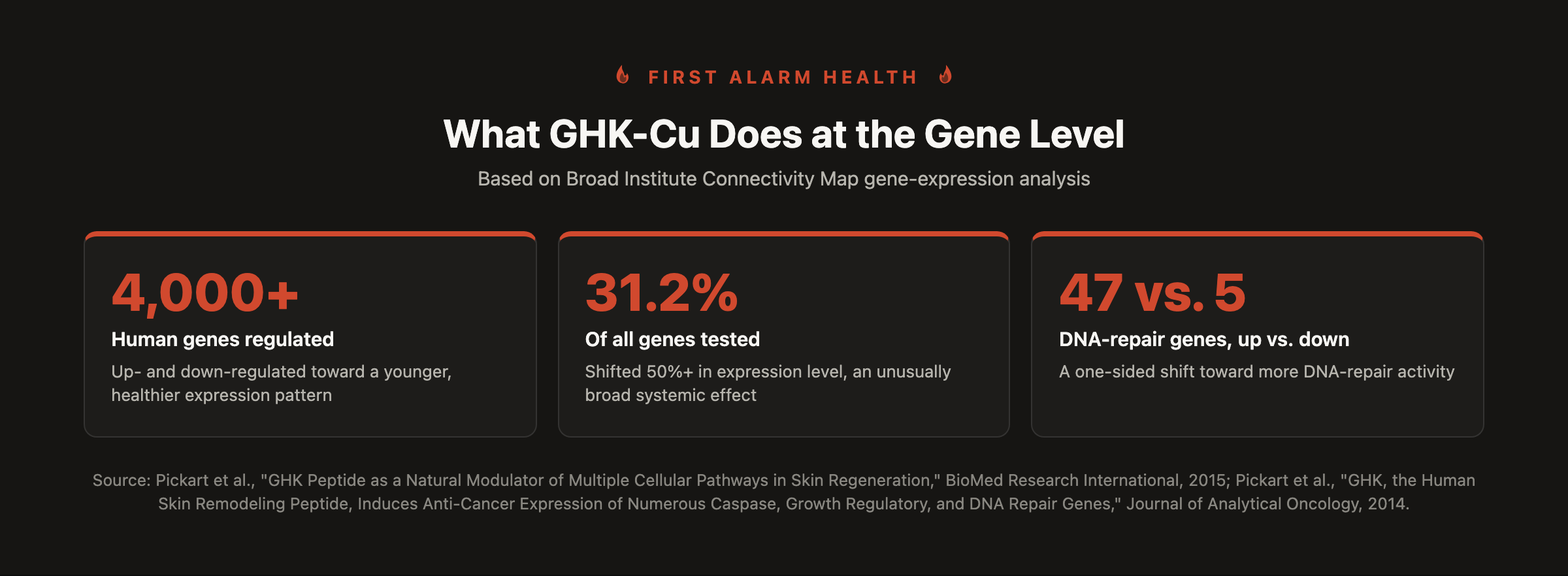
It resets gene expression at scale. This is the most underrated thing about GHK-Cu. Using the Broad Institute’s Connectivity Map, a 2015 review in BioMed Research International found GHK is capable of up- and down-regulating over 4,000 human genes, essentially resetting DNA activity toward a younger, healthier pattern. A follow-up study went further: GHK changes expression by 50% or more in 31.2% of all human genes tested, switches on 6 of the 12 genes that trigger programmed cell death in cancer cells, and shifts 47 DNA-repair genes toward more activity. That’s an enormous, systemic effect for a 3-amino-acid molecule, and it’s the mechanism behind almost everything else on this list.
Tissue repair, broadly. A 2018 review by Pickart and colleagues covers GHK’s repair effects across skin, lung connective tissue, bone, liver, and stomach lining, plus meaningful anti-inflammatory action. In case the terms are new to you, here’s the plain-English version of what it’s actually doing: it increases collagen (the structural protein that gives skin, tendons, and connective tissue their strength), elastin (the protein that lets tissue stretch and snap back into shape instead of staying stretched out), and glycosaminoglycan synthesis, GAGs for short (the gel-like substance that keeps tissue hydrated and cushioned). It also drives angiogenesis, new blood vessel growth, which is a core part of how wounds actually close.
Antioxidant and anti-inflammatory action. Shows up across nearly every paper on this peptide, and pairs naturally with the tissue-repair effects above.
Early, promising angles worth knowing about. GHK’s gene-resetting effect shows up in cancer-cell research too: it reverses the expression pattern tied to metastasis in colon cancer models and activates cell-death genes in breast and prostate cancer cell lines. There’s also early animal work suggesting it may help with age-related cognitive decline. Both are genuinely interesting directions, both are still lab and animal-stage.
Getting it into your system: skin absorption vs. subcutaneous
GHK-Cu doesn’t penetrate skin well on its own, it’s hydrophilic and structurally unstable, which is a real limitation for topical products. That’s exactly why so much current research is chasing better delivery: liposome encapsulation, hydrogels, microemulsions, all trying to get more of it through the skin barrier.
Subcutaneous is the better route, and it’s not close. Injecting it just under the skin skips the permeability problem entirely. Instead of hoping a fraction of it soaks through, you get it directly into your system. If you’re using GHK-Cu for anything beyond surface-level skin cosmetics, subcutaneous is the route that actually gets it to do what it’s supposed to do.
What people actually report
There’s no formal safety-trial data here, same as almost every peptide in this category, so this section is word of mouth and practitioner experience, not a clinical safety profile. Take it as anecdotal.
Most commonly reported: mild injection-site redness or irritation that settles down on its own. On the topical side, some people report skin dryness or minor irritation, occasionally increased facial hair with heavy topical use. On the positive side, the most consistent reports are reduced hair shedding, visibly improved skin quality, and better hydration.
Personally, I get a slight stinging sensation right at the injection site. Lasts maybe 30 minutes tops, then it’s gone. Nothing crazy, totally tolerable, just worth knowing about ahead of time so it doesn’t catch you off guard.
People with copper sensitivity, Wilson’s disease or other copper metabolism issues, and pregnant or nursing women should sit this one out or talk to a doctor first, that’s a caution that shows up consistently in practitioner guidance even without formal trial data behind it.
Forms and general dosing landscape
This is general education, not a protocol to follow. Nobody’s run a dose-finding human trial on this, so anything below is industry-reported, not clinically established.
- Subcutaneous (preferred). Industry-reported ranges run 1-3 mg per injection, 2-4 times per week. Some protocols cycle it, 4 weeks on, 4 weeks off, to avoid copper buildup or depleting competing zinc stores.
- Topical. A small, consistent amount applied once or twice daily. Fine for surface-level skin use, but limited by the absorption problem above.
Why I’d pick GHK-Cu over TB-500
People ask me this a lot, since both get sold for tissue repair. Here’s the honest version, no data dump:
- They’re going after the same job. Both get used for tissue repair and recovery. If you’re comparing them, you’re comparing them for a reason.
- GHK-Cu works at a deeper level. That gene-expression effect from earlier, up- and down-regulating over 4,000 human genes, is a systemic, whole-body mechanism. TB-500’s evidence base doesn’t have anything close to that scale behind it.
- GHK-Cu has decades of real-world use behind it. It’s been in cosmetic products for 40+ years. TB-500 is newer to the civilian research-peptide market, with a much shorter real-world track record.
- GHK-Cu isn’t a banned substance. TB-500 is. TB-500 is on WADA’s Prohibited List, banned at all times, in and out of competition. If you’re a competitive athlete or work somewhere with drug testing, that’s a real risk GHK-Cu simply doesn’t carry.
- GHK-Cu is meaningfully cheaper. It’s a 3-amino-acid molecule, about as simple and cheap to produce as peptides get, typically running well under $1/mg at retail. TB-500 is a longer peptide and costs more per mg across the board.
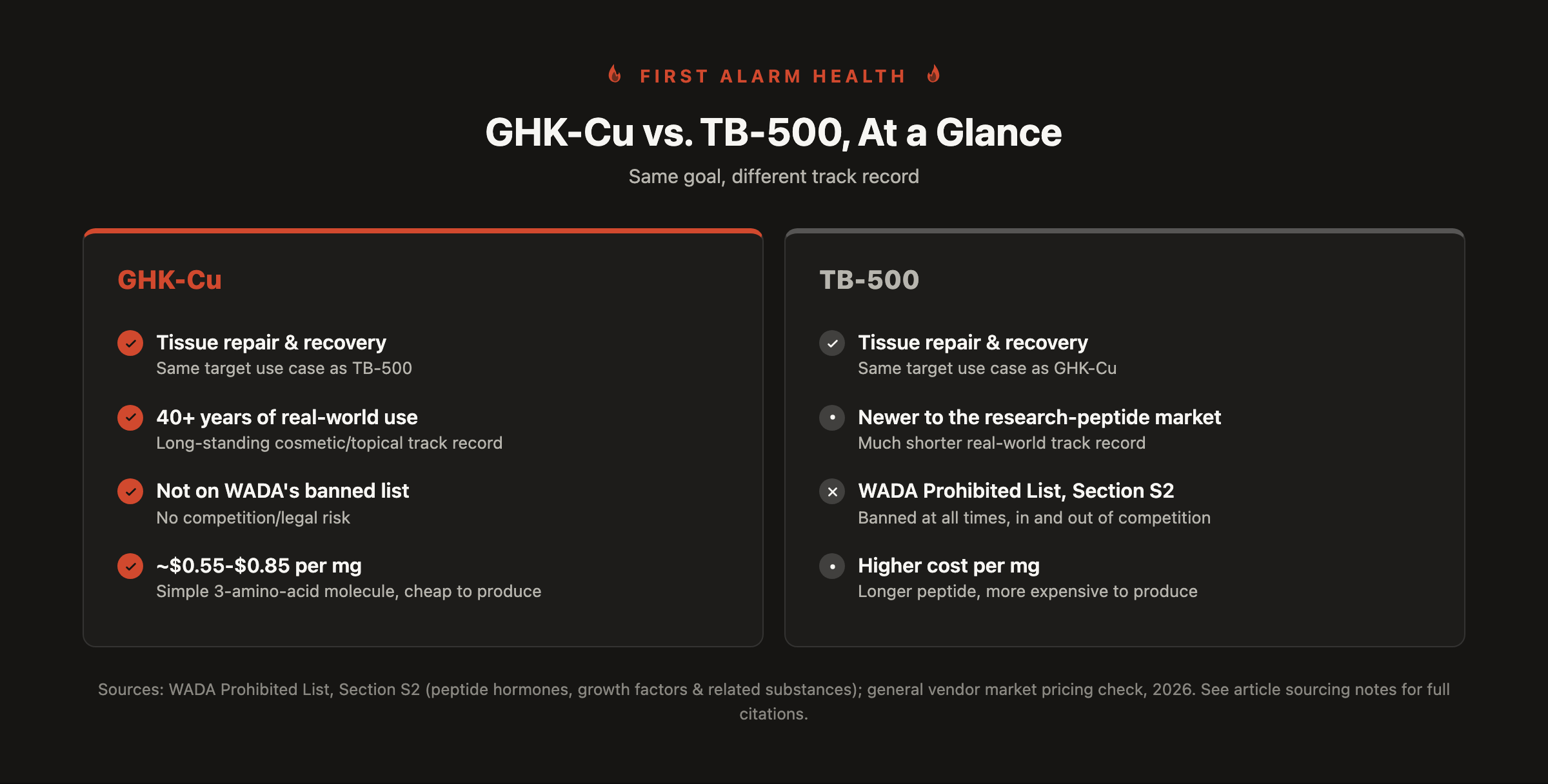
Put those together and GHK-Cu is the easier recommendation: similar goal, longer safety track record, no legal exposure, lower cost.
Bottom line
GHK-Cu has real depth behind it: a gene-expression effect that touches thousands of genes, solid collagen and tissue-repair data, and a genuinely long safety track record. Get it into your system the right way, subcutaneous, not just a cream, and it’s one of the more well-rounded peptides in this whole category.
For research use only. Nothing here is medical advice.
Shop: First Alarm Health