Cancer cells run on sugar. Not as a metaphor, as biochemistry. Most tumors get the bulk of their energy from glucose fermentation even when there’s plenty of oxygen around to do it the normal way. It’s called the Warburg effect, named after the guy who discovered it in the 1920s, and it’s the reason “cut the sugar, starve the tumor” isn’t just wellness-influencer talk. There’s a real mechanism behind it.
That’s the idea behind using a ketogenic diet as a cancer therapy. Drop carbs low enough, and your body shifts to running mostly on fat and ketones instead of glucose. Normal cells adapt to that fuel switch just fine. Cancer cells, dependent on glycolysis, theoretically don’t.
Here’s what the research actually backs up, and where it stops.
What the Mouse Data Actually Shows
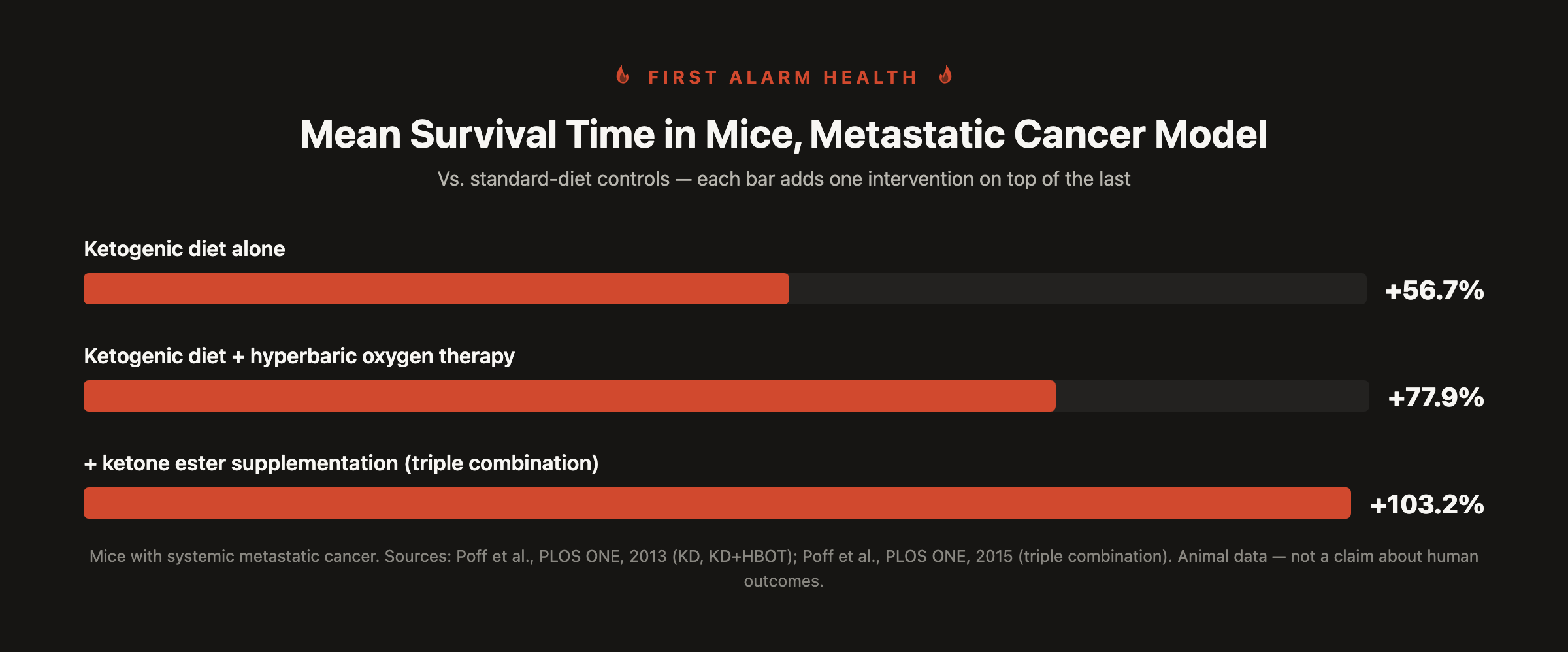
Researchers studying ketogenic diets in cancer have published some genuinely compelling animal data. In mice with systemic metastatic cancer, a ketogenic diet alone increased mean survival time by 56.7% compared to standard diet controls. Combine it with hyperbaric oxygen therapy (basically saturating the tumor with oxygen, which cancer cells handle worse than normal cells), and that jumps to a 77.9% increase. Add ketone ester supplementation into a triple-combination protocol, and a follow-up study found survival more than doubled: 103.2% longer than controls.
Those are real numbers from real published research, not hype. Worth knowing.
What Happens in Actual Humans
This is where it gets honest. There’s no shortage of mouse data. There’s almost no human data.
Take the Keto-CARE trial, one of the better-designed human studies out there: 20 women with stage IV metastatic breast cancer, following a ketogenic diet during chemotherapy. It wasn’t even a randomized trial by the end, everyone eligible self-selected into the keto arm and COVID killed the control group recruitment. Fifteen women made it through the first three supervised months. Nine finished the full six.
What it found: keto is genuinely achievable during chemo, safely, for six months, with no adverse diet-related events. Body weight dropped 10%, mostly fat. Fasting insulin dropped 30%. Insulin resistance dropped 38%. Real, measurable metabolic improvement.
What it didn’t measure: tumor response. Survival. The actual thing you care about if you’re the one with the diagnosis. That trial, like most of what exists in humans right now, was built to answer “can people actually do this,” not “does it work.”
That’s the current state of the science. Promising mechanism. Strong animal data. Basically no human trials big enough or long enough to say a ketogenic diet treats cancer.
Worth saying plainly: even the researchers who study this exact question don’t claim otherwise. The honest summary of where a ketogenic diet fits in cancer care is that it can take “the foot off the gas pedal” of cancer growth, as an add-on to standard treatment, explicitly not as a standalone therapy. That’s a meaningfully different claim than “the best diet for fighting cancer,” and it’s the accurate one.
Why “Best Diet for Fighting Cancer” Is the Wrong Framing
If you’re mid-treatment right now, this part matters more than the mechanism does. A ketogenic diet is not automatically the right move during active cancer treatment, and for some people it’s actively the wrong one.
Cancer cachexia, the muscle and fat wasting that shows up in a lot of advanced cancer, needs more calories and protein coming in, not carb restriction. Some chemo and immunotherapy regimens have their own nutritional requirements that a hard keto approach can work against. And staying in ketosis while eating enough total food to avoid losing weight you can’t afford to lose is genuinely difficult, even for someone not also dealing with nausea, taste changes, or fatigue from treatment.
Don’t start a ketogenic diet during active cancer treatment without your oncology team involved. Not a suggestion, a hard line. The mechanism is real and worth understanding. Turning it into a DIY treatment plan without medical supervision is not the same thing as understanding it.
There’s no blanket answer here. It depends on the person: their cancer type, how active they are, whether they can actually keep protein and total calories up on a low-carb approach. Someone frail with low muscle mass and a poor appetite is a different case entirely than someone active with a good baseline going into treatment, and the diet advice for those two people shouldn’t be the same.
The Number That Might Matter More Than Any of This
Here’s the part of this conversation that deserves more attention than it usually gets: muscle mass.
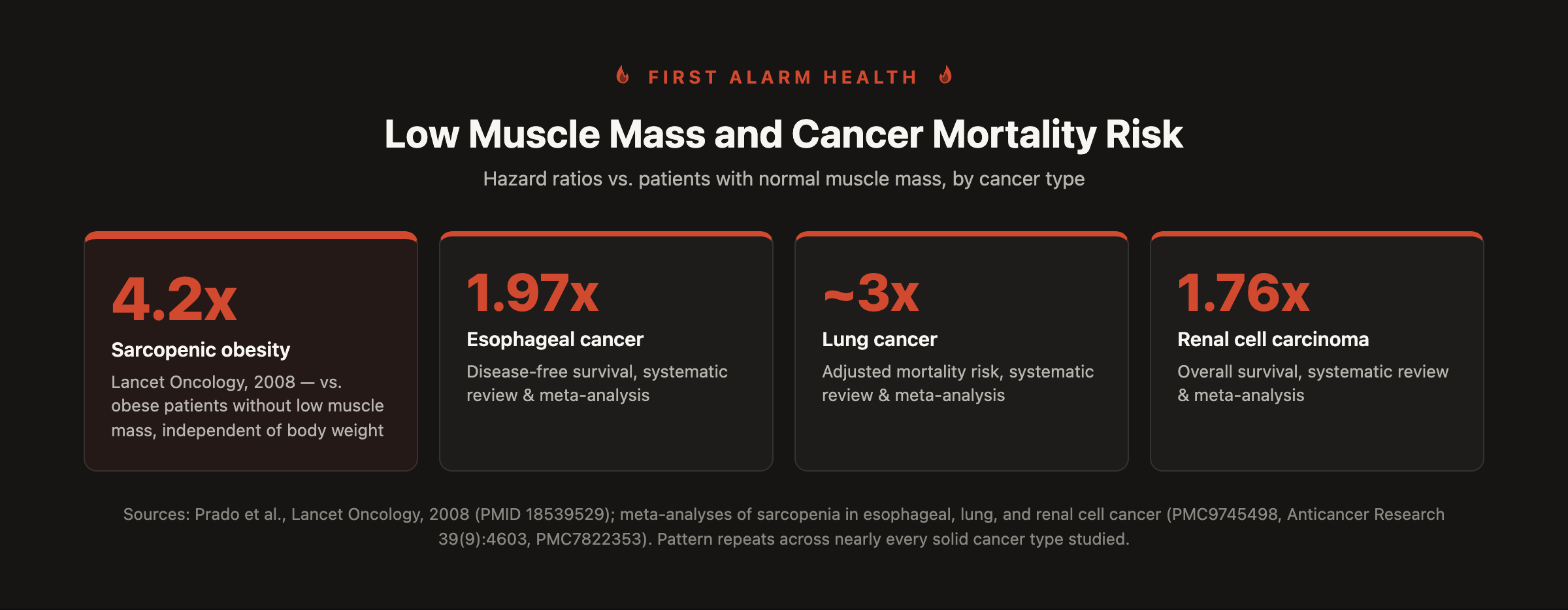
A 2008 study published in Lancet Oncology looked at obese cancer patients with lung and GI tumors and split them by whether they also had sarcopenia, meaning low muscle mass, something you can be dealing with even while carrying extra body fat. The patients with sarcopenic obesity had a hazard ratio of 4.2 for survival compared to obese patients without it. Over four times the risk, and it held up independent of body weight itself.
That’s not a one-off finding. It’s the same pattern across nearly every solid cancer type researchers have looked at:
- Esophageal cancer: sarcopenia linked to a hazard ratio of 1.68 for overall survival, 1.97 for disease-free survival
- Lung cancer: roughly double the death risk unadjusted, closer to triple after adjusting for other factors
- Renal cell carcinoma: hazard ratio of 1.76
- Solid tumors treated with immunotherapy broadly: hazard ratio of 1.58 for overall survival, 1.50 for progression-free survival
One researcher in this space cited a similar figure from his own analysis: splitting cancer patients into quartiles by muscle mass at diagnosis, the top 25% had roughly double the 10-year survival probability of the bottom 25%. Treat that specific number as directionally consistent with the peer-reviewed data above rather than independently verified to the same standard, but it points the same direction every published study on this does.
Why does muscle matter this much? A few real mechanisms, not just “strength is good.” Muscle is functional reserve, the buffer that lets a body tolerate surgery, chemo, and radiation without breaking down. Chemo dosing is usually calculated off body surface area, not lean mass, so a low-muscle patient can end up relatively overdosed and hit with more toxicity and more dose reductions than someone carrying more muscle at the same body weight. And skeletal muscle isn’t just a battery, it’s active tissue involved in immune function and metabolic regulation, which matters plenty when the whole fight is your immune system against abnormal cells.
Where These Two Things Actually Connect
Here’s the part worth saying as plainly as possible: doing a ketogenic diet without resistance training and enough protein isn’t neutral. It actively works against the one thing in this whole picture with the strongest evidence behind it. Cut carbs, skip the protein, skip the lifting, and you’re on a fast track to losing muscle. That’s not a minor side effect. Muscle mass is the most consistent predictor of cancer survival in everything covered above, better established than anything the ketogenic diet itself has shown in humans.
Put bluntly, that’s a bad trade. You’d be taking on real difficulty (strict carb restriction, a real risk of losing muscle if you’re not deliberate about it) for a mechanism that’s proven in mice and promising in the lab, while potentially giving up ground on the one variable that’s proven across a decade-plus of human data in nearly every cancer type.
That’s not an argument against ketogenic diets. It’s an argument that resistance training and protein aren’t optional extras bolted onto the diet, they’re what makes the whole approach defensible in the first place. Keto without training isn’t a lesser version of the same plan. It’s a different, worse plan.
To be direct about it: this isn’t “pick keto or pick muscle-building.” If you’re going to do a ketogenic approach around a cancer diagnosis, the two go together, deliberately, not one instead of the other. Keto alone risks losing the muscle mass with the strongest survival evidence in this entire article. Training alone skips whatever the metabolic mechanism might add. Do both, and you get the possible upside of the diet without gambling away the one thing that’s actually proven to matter.
One distinction worth keeping straight, though: that’s the case for fighting an existing diagnosis, where keto’s mechanism is specifically an add-on to treatment. For preventing cancer in the first place, before any diagnosis, the strongest evidence isn’t specific to keto at all. It’s general metabolic health, a healthy body weight, and good muscle mass, achievable through more than one style of eating. The Warburg-effect mechanism above is about slowing existing tumors, not a proven prevention protocol. Muscle mass matters for prevention and treatment both. The keto-specific piece is really about the treatment side.
What to Actually Do With This
-
Talk to your oncology team before changing anything about your diet during treatment. This isn’t a formality. Cachexia, treatment-specific nutrition needs, and your individual case all change the calculus, and they’re the ones who can see your full picture.
-
If you’re doing a ketogenic or low-carb approach, resistance training and hitting your protein target are not optional. This is the single biggest lever in this whole article. Skip it, and you risk trading away the strongest, best-established survival factor in oncology for a mechanism that’s still unproven in humans. Don’t do one without the other.
-
Ask specifically about a registered dietitian who specializes in oncology nutrition, if you’re in active treatment. This is a real subspecialty. General nutrition advice, including this article, isn’t a substitute for someone managing your specific case.
-
Treat the mechanism as real and the treatment claim as unproven. Both things are true at once. The Warburg effect is legitimate biochemistry. “Ketogenic diet cures cancer” is not yet a claim the human research supports.
This isn’t medical advice, especially not for anyone currently in cancer treatment. Talk to your oncology team before changing your diet.
Got questions about any of this? Get in touch, happy to talk it through.
Shop: First Alarm Health