For research use only. Nothing below is medical advice. Talk to your doctor before starting anything, especially if you have an existing health condition.
Every conversation I have about peptides starts the same place. Someone asks me what they even are. Before we get anywhere near “should I try one.”
Fair question.
Most people’s only reference point is “peptide” and “Ozempic” showing up in the same sentence on the news. That’s maybe 5% of the actual picture.
So before any myth-busting or product-picking, here’s the on-ramp. What a peptide actually is. How it works in your body. Why this went from a niche corner of the internet to something your coworkers are casually asking about.
What a peptide actually is
Strip away the marketing and the definition is simple. A peptide is a short chain of amino acids linked together by peptide bonds. That’s it.
Amino acids are the building blocks. String a handful together and you’ve got a peptide. String together a lot more, usually past 50 amino acids, and it folds into a 3D shape. At that point it’s called a protein instead.
So peptides and proteins aren’t different categories. Same basic chemistry, different sizes.
Insulin is a peptide. 51 amino acids. Oxytocin, the “bonding hormone,” is a peptide too. Just 9 amino acids. Glucagon, the hormone that raises your blood sugar, is a peptide.
None of that is exotic or new. Your body’s been making peptides your whole life, long before anyone started selling them.
How they actually work
This is the part that trips people up most. Here’s the precise version.
Peptides work as signaling molecules. They don’t get inside your cells and rewrite anything. They bind to a receptor sitting on the outside of a cell, like a key fitting a lock. That binding tells the cell to do something it’s already capable of doing.
Release more growth hormone. Trigger a repair process. Adjust appetite signaling.
Compare that to an anabolic steroid. Steroids are small and fat-soluble enough to cross directly into a cell and bind DNA inside the nucleus. They rewrite which genes get expressed.
Peptides mostly work from the outside in. Nudging systems your body already runs instead of overriding your genetics from the inside. Different mechanism. Different downstream effects. That’s a big reason the risk profile between the two categories isn’t close.
Why this category is having a moment right now
A few things converged at once.
GLP-1 drugs went mainstream. Semaglutide (Ozempic, Wegovy) and tirzepatide (Mounjaro, Zepbound) are peptides. GLP-1/GIP receptor agonists, to be precise. They’ve been front-page news for two straight years because of how much weight loss shows up in the trial data.
Retatrutide is next in line. A triple agonist working across GLP-1, GIP, and glucagon receptors at once. Up to 24.2% mean weight loss at 48 weeks in phase 2 trials, some of the most aggressive results in the category so far. Not FDA-approved yet, but a good preview of where this is headed.
This was the first time most non-fitness, non-biohacker people ever heard the word “peptide” attached to something that actually worked. It cracked the category wide open.
The FDA-approval list is bigger than people realize. Insulin and its analogs. Oxytocin. Octreotide. Liraglutide. Dulaglutide. Exenatide. Peptide drugs have quietly been part of mainstream medicine for decades. Roughly 100 to 130 peptide drugs currently have market approval across metabolic, hormonal, and oncology use.
“Unregulated research chemical” was never an accurate description of the whole category. It’s always been a mix of decades-old approved medicine and newer research compounds. That’s exactly why “are peptides safe” is never a one-size-fits-all question.
And it’s not just a U.S. list. Semaglutide and tirzepatide were both reviewed and approved by European and Japanese regulators within roughly a year or two of their FDA approvals. Ozempic’s EMA approval landed just two months after the FDA’s. The “American breakthrough” framing undersells how globally reviewed these drugs actually are.
Go further down the list and you’ll find peptides that are approved, prescribed medications elsewhere in the world while still carrying a “research use only” label here. Selank completed Phase III trials for anxiety and was approved by the Russian Ministry of Health back in 2009. Semax has real human stroke-recovery data behind it and is used clinically in Russia for cognitive and neurological support.
Neither has gone through the FDA pipeline. “No FDA approval” in the U.S. isn’t the same claim as “never tested in humans.” It just means the U.S. specifically hasn’t reviewed it.
And no FDA approval doesn’t automatically mean unsafe. That assumption trips up a lot of otherwise careful people. Here’s why it happens.
Getting a compound through the full FDA pipeline costs $1 to $2 billion and takes 10 to 15 years. That bet only makes sense if a company can patent the compound and sell it exclusively long enough to earn the money back.
A lot of the peptides people ask me about, BPC-157 is the textbook case, are naturally occurring sequences that are difficult or impossible to patent. A company could spend a billion dollars proving it works, and a compounding pharmacy could legally sell a generic version the next day. Nobody’s funding that math.
So the approval gap for compounds like this is a patent-economics problem. Not a verdict on safety. “Unproven” and “dangerous” are two different claims. Don’t collapse them into one.
I go deeper on this exact reasoning trap, plus the real human-data status of specific peptides, in the myths article.
The recovery and performance crowd found their own corner of it. Separately from the metabolic peptides, things like BPC-157 and TB-500 built a following in gyms, combat sports, and, relevant to me, first-responder and shift-work circles. Tissue repair and recovery.
Different peptides. Different mechanism. Same broad category. That’s a big reason people get confused and treat “peptides” like one thing.
The categories, briefly
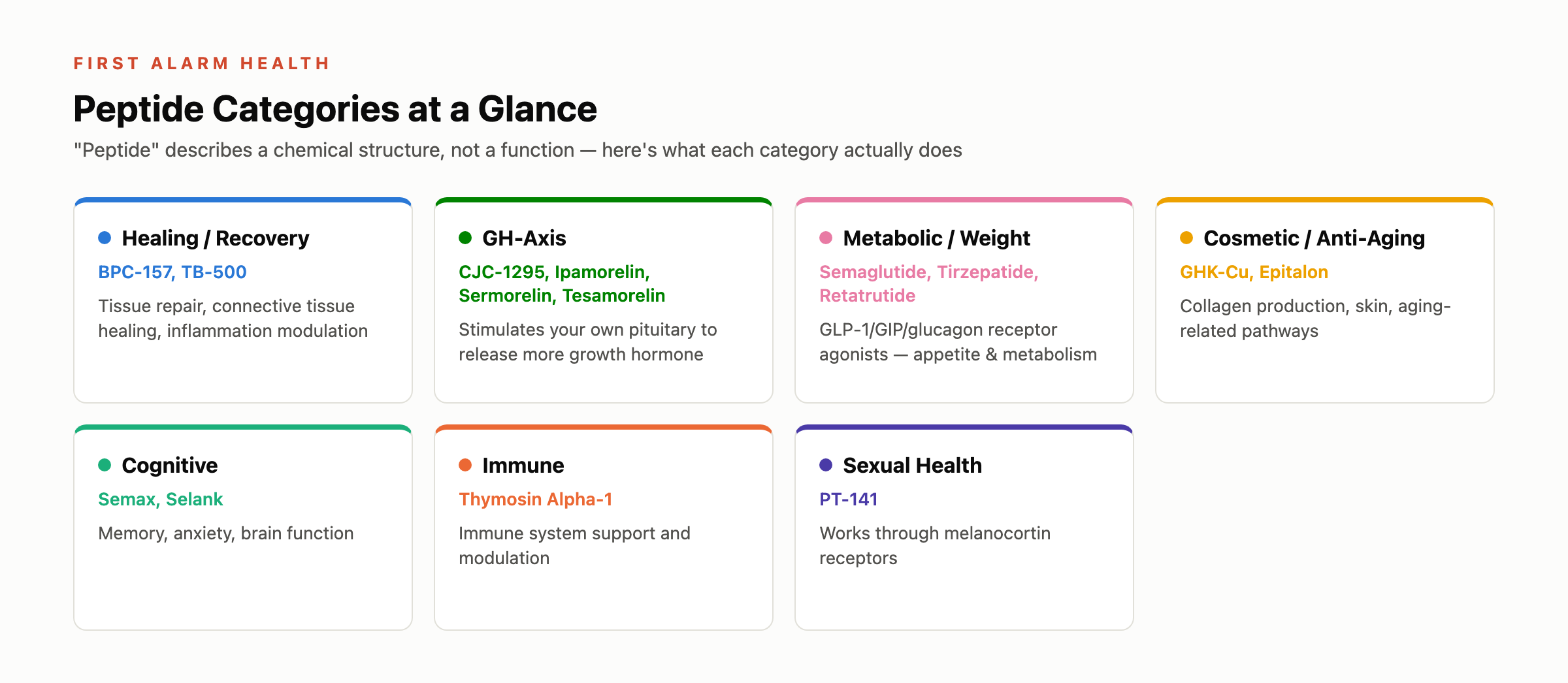
“Peptide” describes a chemical structure, not a function. What any specific one actually does depends entirely on which peptide and which receptor it’s targeting. Broad strokes:
- Healing/recovery: BPC-157, TB-500. Tissue repair, connective tissue healing, inflammation modulation.
- GH-axis: CJC-1295, Ipamorelin, Sermorelin, Tesamorelin. Stimulate your own pituitary to release more growth hormone.
- Metabolic/weight: semaglutide, tirzepatide, Retatrutide. GLP-1/GIP/glucagon receptor agonists affecting appetite and metabolism.
- Cosmetic/anti-aging: GHK-Cu, Epitalon. Collagen, skin, aging-related pathways.
- Cognitive: Semax, Selank. Memory, anxiety, brain function.
- Immune: Thymosin Alpha-1.
- Sexual health: PT-141.
I go a lot deeper on the safety profile of each of these categories in the myths article. Read that one next if you want the “okay but is this actually safe” version of this conversation.
How they’re actually taken
Most peptides are dosed by subcutaneous injection. A small needle just under the skin, not into muscle. That’s not a scare tactic. It’s just how the chemistry works.
Peptides are proteins. Your digestive system’s entire job is breaking proteins down. Swallow most of them and they’re destroyed before they ever reach your bloodstream. Injectable bioavailability runs close to 100%. Oral versions of the same peptide often run under 1 to 2%. That’s why oral semaglutide needs roughly 28 times the dose of the injectable version just to get a fraction of the effect.
There are exceptions emerging. Oral GLP-1 formulations exist now. But as a rule, injection is still how this category works. And it’s a lot less intimidating in practice than people assume before they’ve actually done it.
What “research use only” actually means, and why it matters
You’ll see “for research use only” on basically everything in this space, including this article. It’s not a wink-wink loophole. It’s the accurate legal and regulatory status for most of these compounds in the U.S. right now.
Some peptides in this category are FDA-approved prescription drugs. Semaglutide, tesamorelin. Others, like BPC-157, are not approved, and the FDA has taken active steps limiting how compounding pharmacies can use it. That’s a real distinction, not just fine print.
I’ll go deeper on sourcing and labels in a future article. It’s genuinely one of the more important parts of doing this responsibly.
Where to go from here
This was the 30,000-foot view on purpose. Enough to actually understand what you’re looking at the next time you see “BPC-157” or “GLP-1” mentioned somewhere. From here, the natural next step is the myth-busting piece. What’s actually true versus internet fear and hype.
Got a question this didn’t answer? Get in touch. That’s exactly the kind of thing that gets the next article written.
For research use only. Nothing here is medical advice.
Shop: First Alarm Health